Interactive Brokers Review 2026: Features, Fees, Trading Platforms, Markets & Complete Guide for Investors
Description
Table of Contents
- Introduction
- What Is Interactive Brokers?
- Company Background
- Why Interactive Brokers Is Popular
- Key Features
- Trading Platforms
- Supported Markets
- Account Types
- Trading Tools
- Research & Education
- Security
- Fees
- Pros & Cons
- Interactive Brokers vs Other Platforms
- FAQs
- Final Verdict
Introduction
Interactive Brokers has become one of the world’s most recognized online brokerage firms by offering access to a wide range of global financial markets through a single account. Whether someone is interested in stocks, ETFs, options, futures, bonds, mutual funds, or foreign exchange, the platform provides tools designed for both active traders and long-term investors.
Unlike many brokers that focus on one country or a limited selection of products, Interactive Brokers provides access to markets in numerous countries. This broad market access, combined with advanced trading technology and research tools, has made it a well-known choice among experienced investors.
This guide explains how Interactive Brokers works, the features it offers, its strengths and limitations, and the factors investors should consider before opening an account.
What Is Interactive Brokers?
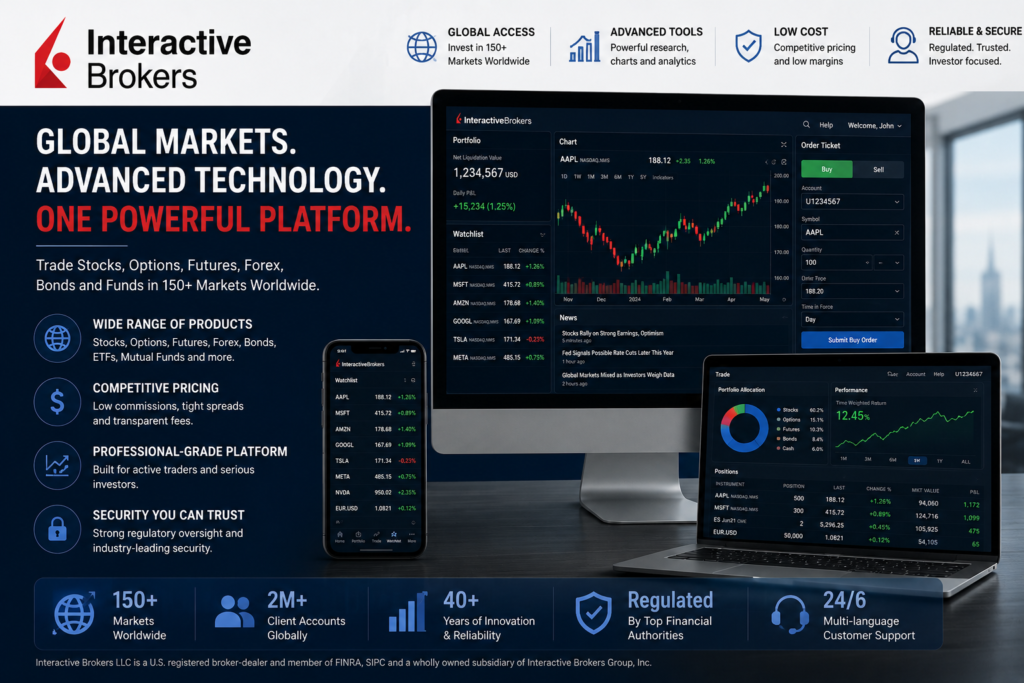
Interactive Brokers is an online brokerage company that provides access to multiple financial markets through desktop, web, and mobile trading platforms. It supports trading and investing across numerous exchanges worldwide.
The company is known for its technology-driven approach, allowing investors to manage diversified portfolios from a single account while offering a wide range of analytical and research tools.
Interactive Brokers serves different types of clients, including individual investors, financial professionals, institutions, and businesses.
Company Background
Interactive Brokers has operated in the brokerage industry for decades and has expanded its services to support clients in many countries. Throughout its history, the company has focused on developing technology that enables efficient market access, portfolio management, and trade execution.
Over time, the platform has added support for additional asset classes, improved its research capabilities, and introduced modern trading interfaces to serve investors with different levels of experience.
Why Interactive Brokers Is Popular
Several characteristics contribute to the platform’s reputation:
Global Market Access
Investors can access a broad range of exchanges instead of being limited to a single domestic market.
Multiple Asset Classes
The platform supports stocks, ETFs, options, futures, bonds, mutual funds, and foreign exchange, allowing investors to build diversified portfolios.
Professional Trading Technology
Interactive Brokers offers several trading platforms with different levels of complexity, making it suitable for a wide range of users.
Research Resources
Market news, analytical tools, company information, and portfolio analysis features help users make informed decisions.
Flexible Platform Choices
Rather than providing only one interface, Interactive Brokers offers desktop, browser-based, and mobile platforms.
Key Features
Multi-Market Access
One of the platform’s defining characteristics is the ability to access numerous international markets from a single brokerage account.
Portfolio Management
Users can monitor holdings, review performance, and organize investments through integrated portfolio management tools.
Advanced Order Types
The platform supports various order types designed to help investors execute trades according to their chosen strategies.
Watchlists
Investors can create customized watchlists to monitor selected securities and market movements.
Alerts
Price alerts and market notifications help users stay informed about changes affecting their investments.
Reporting
Detailed account reports provide insights into portfolio performance, balances, and transaction history.
Trading Platforms
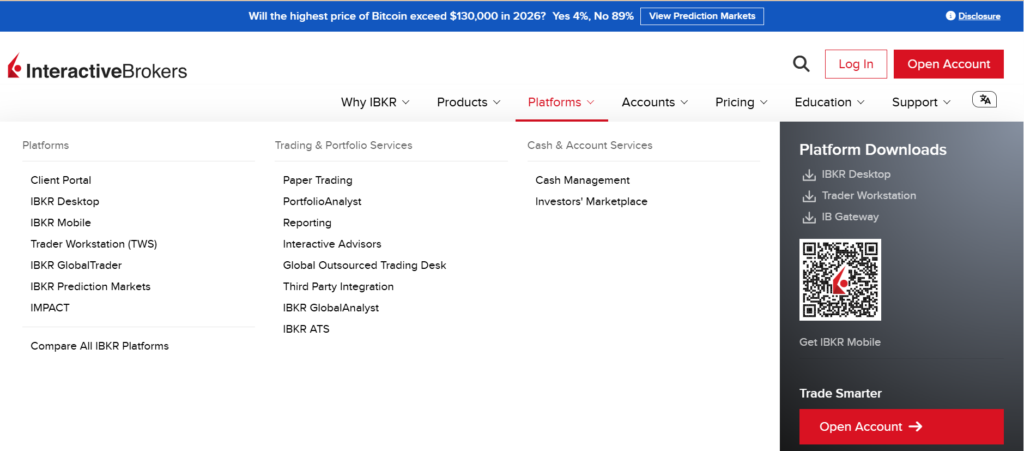
Interactive Brokers offers several trading interfaces tailored to different investing styles.
Trader Workstation (TWS)
Trader Workstation is the company’s professional desktop platform.
Key capabilities include:
- Advanced charting
- Professional order management
- Portfolio monitoring
- Market scanners
- Options analysis
- Risk management tools
Because of its extensive functionality, TWS is often favored by experienced traders.
IBKR Desktop
IBKR Desktop provides a cleaner interface while still offering advanced functionality.
It combines modern design with:
- Market data
- Interactive charts
- Portfolio overview
- News
- Trading tools
Client Portal
The browser-based Client Portal allows investors to:
- Review portfolios
- Transfer funds
- Access statements
- Place trades
- Manage account settings
It offers a convenient option for users who prefer working in a web browser.
Mobile App
Interactive Brokers also provides mobile applications that enable investors to:
- Monitor markets
- Execute trades
- Review positions
- Access account information
- Receive notifications
The mobile experience is designed to support investors who want to manage their portfolios while away from a desktop computer.
Markets Available
Interactive Brokers supports access to numerous asset classes.
Stocks
Investors can buy and sell shares listed on exchanges across different regions.
Exchange-Traded Funds (ETFs)
The platform includes a large selection of ETFs covering sectors, regions, investment strategies, and asset classes.
Options
Options traders can access analytical tools and order types designed to support options strategies.
Futures
Futures markets are available for eligible users seeking exposure to products such as equity indices, commodities, and interest rates.
Foreign Exchange (Forex)
Interactive Brokers provides access to foreign exchange markets, allowing users to trade supported currency pairs.
Bonds
Government and corporate bonds are available for investors interested in fixed-income securities.
Mutual Funds
The platform also supports numerous mutual funds suitable for diversified, long-term investment strategies.
Account Types
Interactive Brokers offers different account structures to meet varying needs.
Individual Accounts
Designed for personal investing.
Joint Accounts
Suitable for two account holders who wish to manage investments together.
Retirement Accounts
Available in eligible regions where supported.
Institutional Accounts
Created for businesses, financial professionals, and organizations with more complex investment requirements.
Advisor Accounts
Designed for registered financial advisors managing client portfolios.
Who Might Find Interactive Brokers Suitable?
Interactive Brokers includes tools that may appeal to:
- Long-term investors seeking diversified market access.
- Experienced traders who value advanced analytical tools.
- Investors interested in international markets.
- Users looking for access to multiple asset classes through a single brokerage account.
The platform’s extensive feature set also means that some beginners may experience a learning curve compared with simpler investing apps.
Fees and Pricing
One of the most important considerations when selecting an online brokerage is understanding its pricing structure. Trading costs can affect overall investment returns over time, especially for active traders.
Interactive Brokers offers different pricing models depending on the account type, product, and region. Because fees can change over time, investors should always review the latest pricing information published by the broker before placing trades.
Commission Structure
The platform provides pricing options that may include commission-based or other fee structures depending on the product being traded. Costs vary across markets and asset classes.
Examples include:
- Stock trading
- ETF trading
- Options trading
- Futures trading
- Forex transactions
- Bond trading
- Mutual fund transactions
The exact cost depends on factors such as market, trade size, product type, and applicable regulations.
Other Costs to Consider
When evaluating any brokerage account, investors should also consider additional expenses beyond trading commissions.
These may include:
- Currency conversion fees
- Market data subscriptions
- Margin interest
- Regulatory fees
- Exchange fees
- Tax obligations
- Withdrawal policies, where applicable
Understanding the complete cost structure helps investors estimate the overall expense of managing their portfolios.
Research Tools
Successful investing often depends on informed decision-making. Interactive Brokers integrates several research resources designed to help investors analyze markets and monitor their portfolios.
Market News
Users can access financial news covering global markets, economic developments, and company updates.
Keeping track of market news can help investors understand factors that influence asset prices.
Economic Calendar
Economic calendars provide information about scheduled events that may affect financial markets.
Common events include:
- Interest rate announcements
- Inflation reports
- Employment data
- GDP releases
- Central bank meetings
Many investors use these events to prepare for periods of increased market volatility.
Company Information
Interactive Brokers provides access to company-specific information that may include:
- Business summaries
- Financial statements
- Earnings history
- Dividend information
- Analyst coverage
- Corporate announcements
These resources support fundamental analysis.
Portfolio Analytics
Portfolio analytics help investors evaluate their overall investment strategy by examining:
- Asset allocation
- Historical performance
- Sector exposure
- Geographic diversification
- Portfolio risk
- Returns over different time periods
Such insights can assist investors in identifying concentration risks or diversification opportunities.
Charting and Technical Analysis
Many investors rely on charts to monitor price movements and identify potential trends.
Interactive Brokers offers charting capabilities that include:
- Multiple chart styles
- Technical indicators
- Drawing tools
- Timeframe customization
- Historical price data
Technical analysis is only one approach to evaluating markets, and many investors combine it with fundamental research before making investment decisions.
Risk Management Features
Managing risk is an essential part of investing.
Interactive Brokers includes several tools that may help users monitor and manage portfolio exposure.
Order Types
Different order types allow investors to specify how trades should be executed.
Examples include:
- Market orders
- Limit orders
- Stop orders
- Stop-limit orders
Each order type serves a different purpose and may be suitable for different trading situations.
Portfolio Monitoring
Investors can regularly review:
- Account balances
- Open positions
- Unrealized gains or losses
- Cash balances
- Margin information (where applicable)
Monitoring portfolio activity can help users stay informed about changes in their investments.
Education and Learning Resources
Learning about investing is an ongoing process.
Interactive Brokers provides educational materials intended to help users understand financial markets and investment concepts.
Topics commonly covered include:
- Stock investing
- Exchange-traded funds
- Options basics
- Portfolio diversification
- Market terminology
- Risk management
- Platform tutorials
Educational resources can be useful for investors who want to improve their understanding before making financial decisions.
Mobile Trading Experience
Mobile investing has become increasingly important as investors seek convenient access to financial markets.
Interactive Brokers offers mobile applications designed for smartphones and tablets.
The app generally allows users to:
- Monitor watchlists
- Review portfolios
- Access charts
- Receive notifications
- Read market news
- Execute trades
The mobile interface provides flexibility for investors who prefer managing investments while away from their computers.
Portfolio Management
A diversified portfolio often includes different asset classes rather than relying on a single investment.
Interactive Brokers supports portfolio management through tools that help investors organize and monitor their holdings.
Users can review:
- Overall portfolio value
- Individual positions
- Asset allocation
- Historical performance
- Cash balances
- Account statements
Portfolio management tools can assist investors in evaluating whether their investments continue to align with their financial goals.
Security Features
Security is an important consideration whenever personal or financial information is stored online.
Investors should review the broker’s official security documentation and make use of available account-protection features.
General online security practices include:
Strong Passwords
Create unique passwords that combine uppercase letters, lowercase letters, numbers, and symbols.
Avoid using the same password across multiple websites.
Multi-Factor Authentication
Where available, enabling multi-factor authentication adds an additional layer of account security beyond a password alone.
Secure Connections
Before entering account credentials, confirm that the website uses a secure HTTPS connection.
Monitor Account Activity
Regularly reviewing account activity can help identify unusual transactions or login attempts.
Device Security
Keeping computers and smartphones updated with the latest operating system and security patches can reduce cybersecurity risks.
Customer Support
Reliable customer support is valuable for both new and experienced investors.
Support options may include:
- Help centers
- Frequently Asked Questions
- Email support
- Live chat
- Telephone assistance
Before opening an account, investors may wish to review the available support channels and service hours.
Advantages of Interactive Brokers
Several characteristics contribute to Interactive Brokers’ reputation among many investors.
Broad Market Access
Access to numerous international exchanges through one brokerage account.
Multiple Investment Products
Support for various asset classes allows investors to diversify their portfolios.
Professional Trading Platforms
The company offers desktop, browser-based, and mobile trading platforms.
Research Integration
Market news, analytical tools, and portfolio reporting are integrated into the platform.
Flexible Account Types
Different account structures serve individual investors, institutions, advisors, and businesses.
Considerations
Every brokerage has characteristics that prospective investors should evaluate carefully.
Some users may find:
- The platform offers a wide range of features that can require time to learn.
- Pricing varies depending on products and markets.
- Certain products may involve additional risks or eligibility requirements.
- Available features can differ by jurisdiction and regulatory requirements.
Understanding these considerations can help investors decide whether the platform aligns with their needs.
Best Practices for New Investors
Before investing through any online brokerage, consider the following practices:
- Define your financial goals.
- Understand your risk tolerance.
- Diversify investments where appropriate.
- Learn about the products you plan to trade.
- Review the brokerage’s pricing structure.
- Enable available security features.
- Monitor your portfolio regularly.
- Stay informed about market developments.
- Invest only funds you can afford to put at risk.
- Continue learning as markets evolve.
Pros and Cons of Interactive Brokers
Every brokerage platform has its strengths and limitations. Understanding both sides can help investors decide whether a platform aligns with their investment goals, experience level, and preferred markets.
Pros
Access to Global Markets
Interactive Brokers provides access to numerous exchanges around the world, allowing investors to build internationally diversified portfolios from a single account.
Multiple Asset Classes
Users can access various investment products, including:
- Stocks
- Exchange-Traded Funds (ETFs)
- Options
- Futures
- Bonds
- Mutual Funds
- Foreign Exchange (Forex)
This broad selection enables investors to manage different investment strategies within one platform.
Advanced Trading Platforms
The company offers multiple interfaces, including Trader Workstation (TWS), IBKR Desktop, Client Portal, and a mobile application. Investors can choose the platform that best matches their experience level and workflow.
Research and Analytics
Integrated research tools, market news, charting, portfolio analytics, and educational materials provide valuable information for investors conducting their own analysis.
Portfolio Diversification
Because Interactive Brokers supports multiple markets and asset classes, investors can diversify across industries, countries, and investment products more easily than on platforms with a narrower focus.
Flexible Account Types
The availability of individual, joint, advisor, institutional, and other account structures makes the platform suitable for a variety of users.
Considerations
Learning Curve
Interactive Brokers offers many advanced features. New investors may need time to become familiar with the platform and its extensive functionality.
Complex Interface for Beginners
Professional trading tools can appear overwhelming to users who have only used simplified investing apps.
Product Availability
Not every investment product is available in every jurisdiction. Access depends on applicable laws, regulations, and account eligibility.
Investment Risk
All investments involve risk. Market values can rise or fall, and there is no guarantee of profit.
Interactive Brokers vs eToro
| Feature | Interactive Brokers | eToro |
|---|---|---|
| Global Market Access | Extensive | Broad but varies by region |
| Asset Classes | Wide range | Multiple asset classes |
| Trading Platforms | Desktop, Web, Mobile | Web and Mobile |
| Research Tools | Extensive | Available |
| Educational Resources | Comprehensive | Available |
| Suitable For | Beginners to advanced investors (with a learning curve) | Many retail investors |
Both platforms offer access to financial markets, but they differ in platform design, available tools, and regional availability. Investors should compare features, fees, supported products, and regulatory information before deciding which service best meets their needs.
Interactive Brokers vs Plus500
| Feature | Interactive Brokers | Plus500 |
| Global Market Coverage | Extensive | Varies by region |
| Trading Platforms | Multiple | Web and Mobile |
| Research Features | Extensive | Available |
| Educational Resources | Broad | Available |
| Mobile Trading | Yes | Yes |
The right choice depends on factors such as investment goals, product availability, user experience, and the specific services offered in the investor’s jurisdiction.
Interactive Brokers vs Bybit
Interactive Brokers and Bybit serve different audiences and offer different products depending on the user’s location and applicable regulations.
Interactive Brokers focuses on a broad range of traditional financial markets and investment products, while Bybit is known for digital asset trading in jurisdictions where its services are available.
When comparing platforms, investors should consider:
- Available asset classes
- Fees and pricing
- Regulatory status in their jurisdiction
- Research and educational resources
- Security features
- Platform usability
- Customer support
Tips for Choosing an Online Brokerage
Before opening an account with any brokerage, consider asking the following questions:
- Does the platform support the markets you want to access?
- Are the fees clear and easy to understand?
- Does it offer research and educational resources?
- Is customer support readily available?
- Does the platform provide appropriate security features?
- Is the user interface suitable for your experience level?
- Are the products available in your country?
- Does the platform align with your long-term financial goals?
Taking time to evaluate these factors can help investors make more informed decisions.
Frequently Asked Questions
What is Interactive Brokers?
Interactive Brokers is an online brokerage that provides access to a range of financial markets and investment products through desktop, web, and mobile trading platforms.
Is Interactive Brokers suitable for beginners?
Some beginners may find the platform useful because of its educational resources and range of products. However, its advanced tools may involve a learning curve compared with simpler investing apps.
What markets can I access through Interactive Brokers?
Depending on eligibility and jurisdiction, users may have access to stocks, ETFs, options, futures, bonds, mutual funds, and foreign exchange markets.
Does Interactive Brokers offer a mobile app?
Yes. The brokerage provides mobile applications that allow investors to monitor markets, review portfolios, and manage their accounts from compatible mobile devices.
What types of accounts are available?
Interactive Brokers offers several account types, including individual, joint, institutional, advisor, and other account structures, subject to regional availability.
How important are research tools when choosing a broker?
Research tools can help investors evaluate companies, monitor markets, and understand economic developments. They are one factor among many to consider when selecting a brokerage.
How can investors improve account security?
General best practices include using strong passwords, enabling multi-factor authentication where available, keeping devices updated, and monitoring account activity regularly.